

POWER DIVIDER


| Home | Products | Services | Technical Support | Profiles |
|
|
|
POWER DIVIDER |
|
| ||||||
|
| |||||||||
|
|
Physical considerations such as internal load on the isolated port will limit
port operation. The coupled output from the directional coupler can be used to
obtain the information (i.e., frequency and power level) on the signal without
interrupting the main power flow in the system (except for a power reduction -
see Figure 2). When the power coupled out to port three is half the input power
(i.e. 3 dB below the input power level), the power on the main transmission line
is also 3 dB below the input power and equals the coupled power. Such a coupler
is referred to as a 90 degree hybrid, hybrid, or 3 dB coupler. The frequency
range for coaxial couplers specified by manufacturers is that of the coupling
arm. The main arm response is much wider (i.e. if the spec is 2-4 GHz, the main
arm could operate at 1 or 5 GHz - see Figure 3). However it should be recognized
that the coupled response is periodic with frequency. For example, a Common properties desired for all directional couplers are wide operational bandwidth, high directivity, and a good impedance match at all ports when the other ports are terminated in matched loads. These performance characteristics of hybrid or non-hybrid directional couplers are self-explanatory. Some other general characteristics will be discussed below. The coupling factor is defined as: where P1 is the input power at port 1 and P3 is the output power from the coupled port (see Figure 1). The coupling factor represents the primary property of a directional coupler. Coupling is not constant, but varies with frequency. While different designs may reduce the variance, a perfectly flat coupler theoretically cannot be built. Directional couplers are specified in terms of the coupling accuracy at the frequency band center. For example, a 10 dB coupling 0.5 dB means that the directional coupler can have 9.5 dB to 10.5 dB coupling at the frequency band center. The accuracy is due to dimensional tolerances that can be held for the spacing of the two coupled lines. Another coupling specification is frequency sensitivity. A larger frequency sensitivity will allow a larger frequency band of operation. Multiple quarter-wavelength coupling sections are used to obtain wide frequency bandwidth directional couplers. Typically this type of directional coupler is designed to a frequency bandwidth ratio and a maximum coupling ripple within the frequency band. For example a typical 2:1 frequency bandwidth coupler design that produces a 10 dB coupling with a 0.1 dB ripple would, using the previous accuracy specification, be said to have 9.6 0.1 dB to 10.4 0.1 dB of coupling across the frequency range. In an ideal directional coupler, the main line loss port 1 to port 2 (P1 - P2) due to power coupled to the coupled output port is:  The actual directional coupler loss will be a combination of coupling loss, dielectric loss, conductor loss, and VSWR loss. Depending on the frequency range, coupling loss becomes less significant above 15 dB coupling where the other losses constitute the majority of the total loss. A graph of the theoretical insertion loss (dB) vs coupling (dB) for a dissipationless coupler is shown in Figure 2. 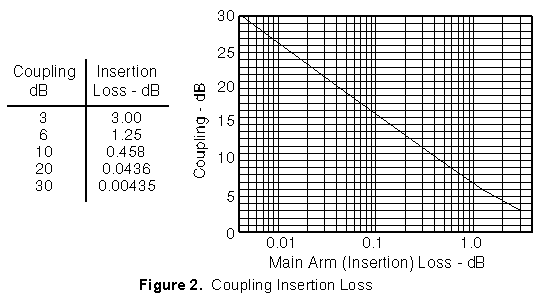 Isolation of a directional coupler can be defined as the difference in signal
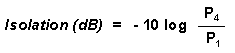
levels in dB between the input port and the isolated port when the two output
ports are terminated by matched loads, or: Isolation can also be defined between the two output ports. In this case, one of the output ports is used as the input; the other is considered the output port while the other two ports (input and isolated) are terminated by matched loads. 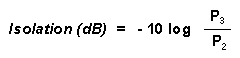 The isolation between the input and the isolated ports may be different from the isolation between the two output ports. For example, the isolation between ports 1 and 4 can be 30 dB while the isolation between ports 2 and 3 can be a different value such as 25 dB. If both isolation measurements are not available, they can assumed to be equal. If neither are available, an estimate of the isolation is the coupling plus return loss. The isolation should be as high as possible. In actual couplers the isolated port is never completely isolated. Some RF power will always be present. Waveguide directional couplers will have the best isolation.
Directivity is directly related to Isolation. It is defined as:  where: P3 is the output power from the coupled port and P4 is the power output from the isolated port. The directivity should be as high as possible. Waveguide directional couplers will have the best directivity. Directivity is not directly measurable, and is calculated from the isolation and coupling measurements as:
The hybrid coupler, or 3 dB directional coupler, in which the two outputs are of equal amplitude takes many forms. Not too long ago the quadrature (90 degree) 3 dB coupler with outputs 90 degrees out of phase was what came to mind when a hybrid coupler was mentioned. Now any matched 4-port with isolated arms and equal power division is called a hybrid or hybrid coupler. Today the characterizing feature is the phase difference of the outputs. If 90 degrees, it is a 90 degree hybrid. If 180 degrees, it is a 180 degree hybrid. Even the Wilkinson power divider which has 0 degrees phase difference is actually a hybrid although the fourth arm is normally imbedded. Applications of the hybrid include monopulse comparators, mixers, power combiners, dividers, modulators, and phased array radar antenna systems. This terminology defines the power difference in dB between the two output ports of a 3 dB hybrid. In an ideal hybrid circuit, the difference should be 0 dB. However, in a practical device the amplitude balance is frequency dependent and departs from the ideal 0 dB difference. The phase difference between the two output ports of a hybrid coupler should be 0, 90, or 180 degrees depending on the type used. However, like amplitude balance, the phase difference is sensitive to the input frequency and typically will vary a few degrees.
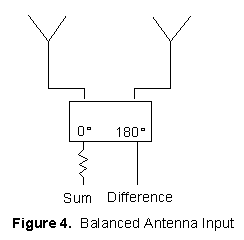
If phase matched lines are used for an antenna input to a 180° hybrid coupler as shown in Figure 4, a null will occur directly between the antennas. If you want to receive a signal in that position, you would have to either change the hybrid type or line length. If you want to reject a signal from a given direction, or create the difference pattern for a monopulse radar, this is a good approach.
Both in-phase (Wilkinson) and quadrature (90°) hybrid couplers may be used for coherent power divider applications. The Wilkinson's power divider has low VSWR at all ports and high isolation between output ports. The input and output impedances at each port is designed to be equal to the characteristic impedance of the microwave system.
Coherent power division was first accomplished by means of simple Tee
junctions. At microwave frequencies, waveguide tees have two possible forms -
the H-Plane or the E-Plane. These two junctions split power equally, but because
of the different field configurations at the junction, the electric fields at
the output arms are in-phase for the H-Plane tee and are anti-phase for the
E-Plane tee. The combination of these two tees to form a hybrid tee allowed the
realization of a four-port component which could perform the vector sum (
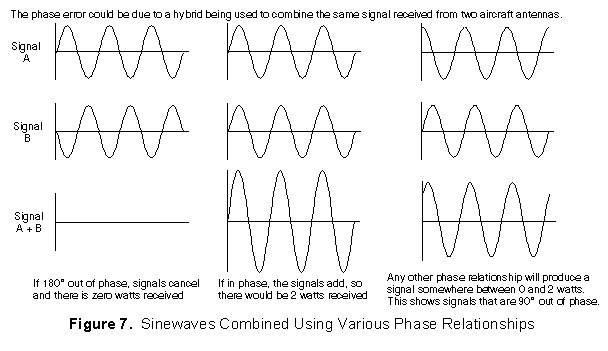
Since hybrid circuits are bi-directional, they can be used to split up a signal to feed multiple low power amplifiers, then recombine to feed a single antenna with high power as shown in Figure 6. 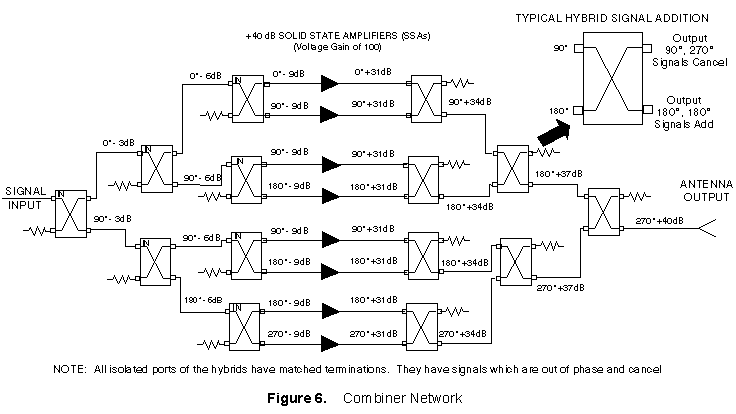 This approach allows the use of numerous less expensive and lower power amplifiers in the circuitry instead of a single high power TWT. Yet another approach is to have each solid state amplifier (SSA) feed an antenna and let the power be combined in space or be used to feed a lens which is attached to an antenna. Sample Problem: If two 1 watt peak unmodulated RF carrier signals at 10 GHz are received, how much peak power could one measure?
 |
 A
directional coupler is a passive device which couples part of the transmission
power by a known amount out through another port, often by using two
transmission lines set close enough together such that energy passing through
one is coupled to the other. As shown in Figure 1, the device has four ports:
input, transmitted, coupled, and isolated. The term "main line" refers
to the section between ports 1 and 2. On some directional couplers, the main
line is designed for high power operation (large connectors), while the coupled
port may use a small SMA connector. Often the isolated port is terminated with
an internal or external matched load (typically 50 ohms). It should be pointed
out that since the directional coupler is a linear device, the notations on
Figure 1 are arbitrary. Any port can be the input, (as in Figure 3) which will
result in the directly connected port being the transmitted port, adjacent port
being the coupled port, and the diagonal port being the isolated port.
A
directional coupler is a passive device which couples part of the transmission
power by a known amount out through another port, often by using two
transmission lines set close enough together such that energy passing through
one is coupled to the other. As shown in Figure 1, the device has four ports:
input, transmitted, coupled, and isolated. The term "main line" refers
to the section between ports 1 and 2. On some directional couplers, the main
line is designed for high power operation (large connectors), while the coupled
port may use a small SMA connector. Often the isolated port is terminated with
an internal or external matched load (typically 50 ohms). It should be pointed
out that since the directional coupler is a linear device, the notations on
Figure 1 are arbitrary. Any port can be the input, (as in Figure 3) which will
result in the directly connected port being the transmitted port, adjacent port
being the coupled port, and the diagonal port being the isolated port.
 /4
coupled line coupler will have responses at n
/4
coupled line coupler will have responses at n
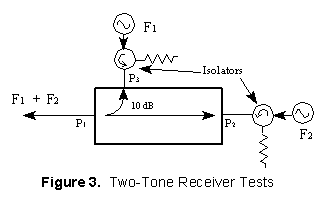 If isolation
is high, directional couplers are excellent for combining signals tofeed a
single line to a receiver for two-tone receiver tests. In Figure 3, onesignal
enters port P3 and one enters port P2, while both exit
port P1. Thesignal from port P3 to port P1
will experience 10 dB of loss, and the signal from port P2 to port P1
will have 0.5 dB loss. The internal load on the isolated port will dissipate the
signal losses from port P3 and port P2. If the isolators
in Figure 3 are neglected, the isolation measurement (port P2 to port
P3) determines the amount of power from the signal generator F2
that will be injected into the signal generator F1. As the injection
level increases, it may cause modulation of signal generator F1, or
even injection phase locking. Because of the symmetry of the directional
coupler, the reverse injection will happen with the same possible modulation
problems of signal generator F2 by F1. Therefore the
isolators are used in Figure 3 to effectively increase the isolation (or
directivity) of the directional coupler. Consequently the injection loss will be
the isolation of the directional coupler plus the reverse isolation of the
isolator.
If isolation
is high, directional couplers are excellent for combining signals tofeed a
single line to a receiver for two-tone receiver tests. In Figure 3, onesignal
enters port P3 and one enters port P2, while both exit
port P1. Thesignal from port P3 to port P1
will experience 10 dB of loss, and the signal from port P2 to port P1
will have 0.5 dB loss. The internal load on the isolated port will dissipate the
signal losses from port P3 and port P2. If the isolators
in Figure 3 are neglected, the isolation measurement (port P2 to port
P3) determines the amount of power from the signal generator F2
that will be injected into the signal generator F1. As the injection
level increases, it may cause modulation of signal generator F1, or
even injection phase locking. Because of the symmetry of the directional
coupler, the reverse injection will happen with the same possible modulation
problems of signal generator F2 by F1. Therefore the
isolators are used in Figure 3 to effectively increase the isolation (or
directivity) of the directional coupler. Consequently the injection loss will be
the isolation of the directional coupler plus the reverse isolation of the
isolator.
 The phase
properties of a 90 degree hybrid coupler can be used to great advantage in
microwave circuits. For example in a balanced microwave amplifier the two input
stages are fed through a hybrid coupler. The FET device normally has a very poor
match and reflects much of the incident energy. However, since the devices are
essentially identical the reflection coefficients from each device are equal.
The reflected voltage from the FETs are in phase at the isolated port and are
180 degrees different at the input port. Therefore, all of the reflected power
from the FETs goes to the load at the isolated port and no power goes to the
input port. This results in a good input match (low VSWR).
The phase
properties of a 90 degree hybrid coupler can be used to great advantage in
microwave circuits. For example in a balanced microwave amplifier the two input
stages are fed through a hybrid coupler. The FET device normally has a very poor
match and reflects much of the incident energy. However, since the devices are
essentially identical the reflection coefficients from each device are equal.
The reflected voltage from the FETs are in phase at the isolated port and are
180 degrees different at the input port. Therefore, all of the reflected power
from the FETs goes to the load at the isolated port and no power goes to the
input port. This results in a good input match (low VSWR).
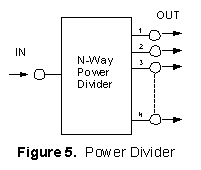 A typical power
divider is shown in Figure 5. Ideally, input power would be divided equally
between the output ports. Dividers are made up of multiple couplers, and like
couplers, may be reversed and used as multiplexers. The drawback is that for a
four channel multiplexer, the output consists of only 1/4 the power from each,
and is relatively inefficient. Lossless multiplexing can only be done with
filter networks.
A typical power
divider is shown in Figure 5. Ideally, input power would be divided equally
between the output ports. Dividers are made up of multiple couplers, and like
couplers, may be reversed and used as multiplexers. The drawback is that for a
four channel multiplexer, the output consists of only 1/4 the power from each,
and is relatively inefficient. Lossless multiplexing can only be done with
filter networks.
 )
and difference (
)
and difference ( ) of two coherent
microwave signals. This device is known as the magic tee.
) of two coherent
microwave signals. This device is known as the magic tee.